Hanoi Travel Guide: Two Weeks in the Old Quarter
Hanoi doesn’t ease you in. You step out of the airport, into the traffic, into the noise and the heat and the smell of charcoal and coffee — and either it overwhelms you or it pulls you straight in. For me it was the second one. I came for a few days and stayed two weeks.
Most of that time I never left the Old Quarter, and I didn’t need to. This is a city best understood on foot and at street level — in the tangle of the thirty-six old streets, on a plastic stool over a bowl of noodles, in a café the size of a cupboard watching the world go past. Hanoi rewards slowing down and staying put more than rushing around ticking off sights.
This is a guide to the city the way I actually experienced it: the coffee, the food, the chaos, and the famous railway line that became the cover image for this whole project.
Getting Into Hanoi
The visa is easier than it used to be. If you’re a UK citizen, you now get up to 45 days in Vietnam visa-free for tourism — you just need a passport valid for at least six months from your date of entry. That covers the vast majority of trips, including a long one like mine. If you’re staying beyond 45 days, or you’re from a country without the waiver, you’ll want the official e-visa (around $25 for single entry), which you apply for online and which is usually approved within a few working days. Apply through the official government portal rather than a lookalike agency site, and you’ll avoid the markup.
From the airport. Noi Bai is about 45 minutes to an hour from the Old Quarter depending on traffic. The simplest options are a Grab (booked through the app) or a pre-arranged hotel pickup. Avoid unmetered taxis that approach you in the arrivals hall — agree the method before you get in.
Where to Stay
For a first trip, stay in or right beside the Old Quarter. It puts you in the middle of everything — the food, the coffee, the markets, the night energy — and Hanoi is a city where being able to walk out of your door into the chaos is the whole point.
A few areas to consider:
- The Old Quarter proper — most central, most atmospheric, and the noisiest. Light sleepers should ask for a room away from the street.
- Around St Joseph’s Cathedral — slightly calmer, very pretty, with some of the best cafés in the city on your doorstep. This was my favourite corner of Hanoi.
- By Hoan Kiem Lake — a touch more space and air, with the lake to walk around in the mornings, and still walking distance to everything.
The Old Quarter
The heart of Hanoi is the maze of narrow streets north of the lake, traditionally each one named for the trade once sold there. You’ll still find streets that are almost entirely one thing — hardware, paper goods, tin, silk, herbs — even now. There’s no efficient way to “do” it and you shouldn’t try. The right approach is to pick a direction, get a little lost, and let the city come to you: a temple tucked between shopfronts, a woman frying something extraordinary on a corner, a café up a staircase you’d never have found if you were following a map.
Two weeks in and I was still turning down streets I hadn’t seen.
Coffee, and the Egg Coffee Thing
Hanoi takes coffee seriously, and you should too. Vietnamese coffee is strong, dark and usually cut with sweetened condensed milk, served hot or poured over ice as cà phê sữa đá — the perfect antidote to the midday heat.
But the city’s signature is egg coffee — cà phê trứng — a rich, almost dessert-like drink topped with a whipped egg-yolk-and-condensed-milk foam that tastes more like tiramisu than anything you’d call coffee. It was invented here in the 1940s at Giảng Café, and drinking one in the original spot, down a little corridor away from the street, is one of those small rituals worth making time for.
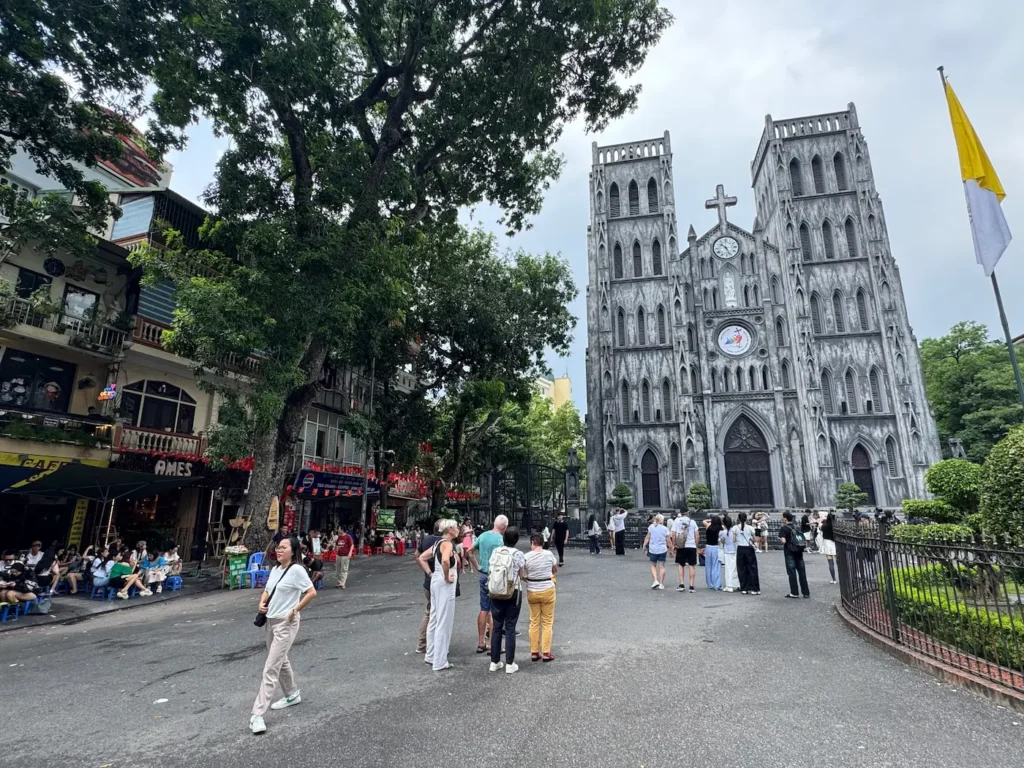
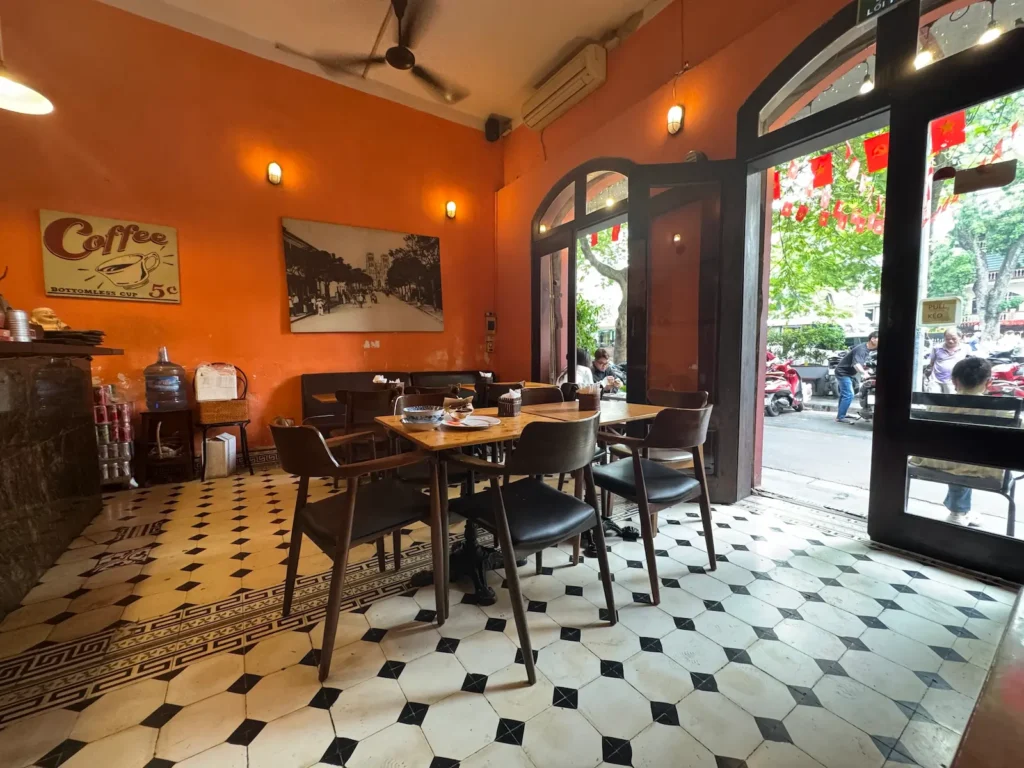
My favourite, though, was for food as much as coffee: La Place, right by St Joseph’s Cathedral. The French name fits that corner of the city perfectly — it’s where Hanoi’s colonial architecture makes complete sense — and I went back more times than I’ll admit. That’s the thing about Hanoi cafés: you don’t visit them, you adopt one.
What to Eat
Hanoi might be the best street food city in Southeast Asia, and the rule is simple: eat where the locals are, sit on the small plastic stool, and don’t overthink it.
What I kept coming back to:
- Bánh mì — the Vietnamese baguette, a legacy of the French, stuffed with pâté, pork, pickled vegetables and chilli. A perfect cheap breakfast or street snack.
- Noodle soups — this is pho country, but Hanoi’s noodle world goes far deeper. Some of the best bowls I had were at tiny, decades-old noodle places near Hoan Kiem Lake, the kind run by the same family for generations, doing one dish and doing it perfectly.
- Market food — the markets are where to eat adventurously. Point, sit, eat, and you’ll usually end up with something better than anything on an English menu.
A word on the famous beer corner: in the evenings, the junction at Tạ Hiện fills with people on tiny stools drinking bia hơi — fresh, cheap draught beer brewed daily. It’s touristy now, but it’s still a fun hour of the night.
Train Street — What’s Actually True in 2026
This is the image most people have of Hanoi: a train squeezing down a impossibly narrow residential lane lined with cafés, inches from the tables. It’s the shot that became the cover of this whole project. But its status changes constantly, and a lot of what you’ll read online is out of date — so here’s where things actually stand.
There are really two Train Streets, and the difference matters:
The famous section (between Trần Phú and Phùng Hưng, near the Old Quarter) is the picture-perfect one — and it’s the one that’s partially restricted. The entrances are barricaded and often manned by police, who will turn away tourists trying to walk in freely. The way in now is through the café owners: one will signal you over, vouch for you to the guard, and walk you to their tables — and in return you buy a drink and stay in their seating area rather than wandering the tracks. It works, but it’s busier and a little more transactional than the photos suggest.
The quieter section (further south, near Hanoi Railway Station / Ga Hà Nội, off Lê Duẩn) is the one I’d actually point you toward. It’s largely unguarded, far less commercial, with a handful of friendly cafés and none of the barrier-and-escort routine. You can settle in, order something, and just wait for the train in peace. It feels more like the place the photos promised.
One important note: organised group tours to Train Street were officially banned in 2025, so ignore any guide telling you to “book a tour in.” Go independently.
And the safety part is not optional. The trains run on weekday evenings (roughly from 7pm) and throughout the day at weekends — but treat any posted timetable as a rough guide, not gospel. When a train is coming, the café staff will whistle and wave everyone back behind the line; get fully behind it, keep bags, straps and feet clear of the track, and never stand on the rails for a photo. The gap is genuinely tiny. Respect it.
Getting Around
Two words: Grab bike. Hanoi’s traffic is, frankly, horrendous — a relentless river of scooters that ignores most rules you think you understand — and trying to cross it on foot is a skill you’ll slowly acquire (the trick is to walk steadily and predictably and let the bikes flow around you; never panic or jump back).
For anything beyond walking distance, I used Grab’s motorbike taxis constantly. You book through the app, the fare is fixed and cheap, and a guy on a scooter weaves you through the chaos far faster than any car could. You’ll get a helmet, you’ll grip the seat, and you’ll arrive grinning. Grab cars are there too if you’d rather have walls around you, but the bike is the real Hanoi experience.
Within the Old Quarter itself, just walk. Everything worth seeing is close, and the walking is the sightseeing.
When to Go
Hanoi has real seasons, unlike the tropical south. Autumn (roughly September to November) is the sweet spot — mild, dry, and the city at its prettiest. Spring (March to April) is also lovely. Winter (December to February) is cool and can be genuinely grey and chilly, so pack a layer. Summer (May to August) is hot, very humid and prone to heavy downpours. If you can choose, go in autumn.
Practical Tips
- Carry cash. Vietnam runs heavily on cash (Vietnamese đồng); card acceptance is patchy outside hotels and bigger restaurants.
- Get the Grab app before you arrive and set up payment — it removes all the haggling and is your lifeline for getting around.
- Cross the road like you mean it. Steady pace, no sudden moves, let the scooters read you. It works.
- Watch the visa clock. 45 days visa-free is generous, but know your limit and your passport’s six-month validity.
- Adopt a café. Find your spot, go back daily, watch the city. It’s the best way to feel Hanoi rather than just see it.
What I Pack
Hanoi is a street-level, run-and-gun kind of city, and the compact setup earns its place here more than anywhere — the DJI Osmo Pocket 3 is small enough to film the markets and the traffic without drawing a crowd, and stabilised enough to shoot from the back of a Grab bike.
Final Thoughts
Hanoi isn’t a city you tick off in two days, and it isn’t trying to be polished or easy. It’s loud and chaotic and occasionally overwhelming — and then you find your café, your noodle place, your way of crossing the road, and suddenly two weeks have gone and you’re not ready to leave.
Stay longer than you think you should. Walk more than you plan to. And drink the egg coffee.
Some of the links in this guide are affiliate links. If you book or buy through them I may earn a small commission at no extra cost to you — it helps keep Wander Cuts going. I only recommend places and gear I’d genuinely use myself.